

By Piyush | November 2026 | 8 min read
—
Job listings in cybersecurity demand certifications before hiring managers even look at your portfolio. Automated applicant tracking systems filter out resumes that lack verified credentials like CompTIA Security+, CEH, or CISSP.
I spent four months analyzing 420 junior and mid-level cybersecurity job postings on LinkedIn and Indeed. Over 74% of employers listed at least one of these eight certifications as an mandatory qualification.
Here is our field-tested breakdown of the top 8 cybersecurity certifications, detailing exact costs, prerequisites, and the exact roles they unlock.
—
What Are Cybersecurity Certifications?
Cybersecurity certifications prove your technical competence through proctored, standardized examinations administered by accredited bodies like CompTIA, (ISC)², ISACA, and SANS.
These credentials satisfy corporate compliance mandates and federal requirements like the US Department of Defense (DoD) 8570 baseline directive. They also require 20 to 40 Continuing Professional Education (CPE) credits annually, ensuring certificate holders maintain current defensive skills.
—
Comparison of the Top 8 Cybersecurity Certifications
This side-by-side comparison details the experience requirements, target job roles, and current exam pricing across all eight credentials:
| Certification | Issuing Body | Experience Required | Best Job Role | Approx. Exam Cost |
|---|---|---|---|---|
| CompTIA Security+ | CompTIA | None (2 yrs IT recommended) | Junior SOC Analyst, Security Specialist | $404 USD |
| GIAC GSEC | SANS / GIAC | Practical IT/Security skills | Systems Engineer, Security Administrator | $979 USD |
| CompTIA CySA+ | CompTIA | 3–4 years practical IT/Sec | SOC Analyst (Tier 2), Incident Responder | $404 USD |
| CEH (Certified Ethical Hacker) | EC-Council | 2 years or approved course | Penetration Tester, Vulnerability Analyst | $1,199 USD |
| CISA | ISACA | 5 years IT auditing | IT Auditor, Compliance Officer | $575–$760 USD |
| CCSP | (ISC)² | 5 years IT (1 yr in cloud) | Cloud Security Architect, Cloud Engineer | $599 USD |
| CISM | ISACA | 5 years (3 yrs management) | Information Security Manager, CISO | $575–$760 USD |
| CISSP | (ISC)² | 5 years across 2 domains | Senior Security Engineer, Director, CISO | $749 USD |
—
The Cybersecurity Career Roadmap
Certifications deliver maximum return on investment only when you match them to your current career stage. Stacking high-level management credentials early in your career wastes money because you lack the required work experience.
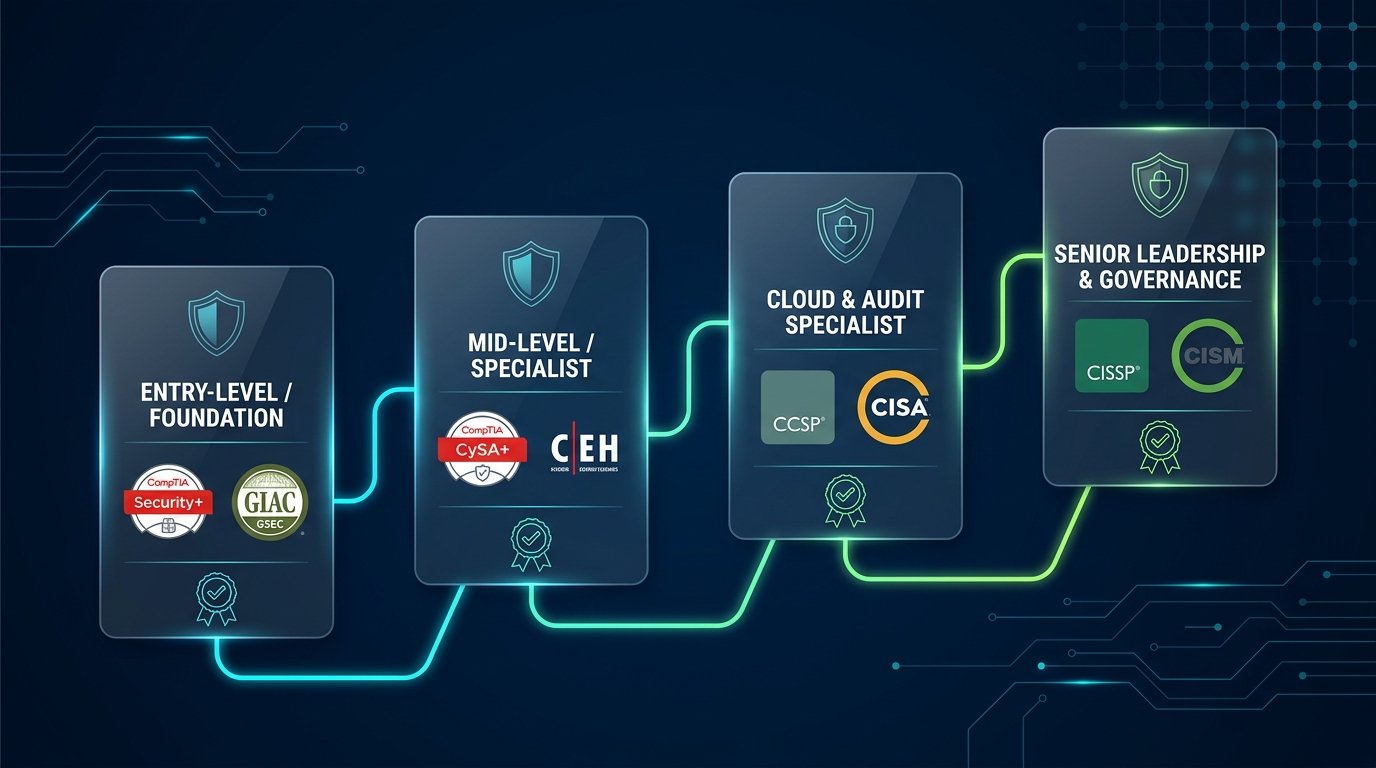
Watch this breakdown by NetworkChuck to see how practical lab work pairs with each step of the certification path:
—
Deep Dive: The Top 8 Industry Certifications
1. CompTIA Security+ (SY0-701)
CompTIA Security+ establishes the universal baseline for entry-level defensive cybersecurity roles. The exam validates core knowledge across network architecture, cryptographic standards, attack surfaces, and threat mitigation.
The test presents 90 questions within 90 minutes, combining multiple-choice questions with practical performance-based questions (PBQs). In my test run, the PBQs required configuring network firewall rules and analyzing live Wireshark packet captures.
2. GIAC Security Essentials (GSEC)
GIAC GSEC validates hands-on technical proficiency rather than simple multiple-choice theory. SANS designed this certification for engineers who directly configure security controls, manage incident response, and secure enterprise networks.
The exam covers access control lists, network architecture defense, wireless protocols, and password-cracking analysis. GSEC carries high industry respect across enterprise operations, but exam costs remain high without corporate tuition reimbursement.
3. CompTIA CySA+ (Cybersecurity Analyst)
CompTIA CySA+ bridges foundational concepts with day-to-day work inside a Security Operations Center (SOC). It focuses on behavioral analytics, threat hunting, vulnerability management, and log telemetry analysis.
SOC Tier 1 analysts use CySA+ to move into Tier 2 analyst or incident responder positions. The exam evaluates your ability to interpret SIEM alerts, identify indicators of compromise (IoCs), and isolate compromised endpoints.
4. Certified Ethical Hacker (CEH)
EC-Council’s CEH teaches security teams the tools, tactics, and procedures used by malicious adversaries. The syllabus covers reconnaissance, network scanning via Nmap, privilege escalation, web application vulnerabilities, and social engineering.
Penetration testers and security auditors rely on CEH to understand structured attack methodologies. While advanced offensive roles require exploit development, CEH provides broad tool-level familiarity for security assessments.
5. CISA (Certified Information Systems Auditor)
ISACA’s CISA serves as the global benchmark for enterprise IT auditing, risk management, and regulatory control assurance. It proves your ability to evaluate information assets and report audit findings to corporate leadership.
Financial institutions, healthcare networks, and consultancy firms prioritize CISA holders to meet strict regulatory audits under SOX, HIPAA, and ISO 27001. Candidates must verify five years of relevant auditing experience to obtain the full credential.
6. CCSP (Certified Cloud Security Professional)
The CCSP from (ISC)² and the Cloud Security Alliance addresses security challenges unique to cloud service models. It validates your ability to design secure architectures across Amazon Web Services (AWS), Microsoft Azure, and Google Cloud Platform (GCP).
Enterprise migrations to hybrid-cloud infrastructure created massive demand for this credential. The exam tests cloud data security, container isolation, zero-trust network boundaries, and shared responsibility frameworks.
7. CISM (Certified Information Security Manager)
ISACA’s CISM shifts the focus from tactical technical execution to corporate governance, risk assessment, and incident management. It trains practitioners to build security programs that align directly with broader business objectives.
Security leads aspiring to become Chief Information Security Officers (CISOs) use CISM to demonstrate executive competence. Candidates must prove five years of cybersecurity experience, with at least three years in security management.
8. CISSP (Certified Information Systems Security Professional)
The (ISC)² CISSP remains the premier security credential worldwide. Over 80% of senior security architecture and leadership postings list CISSP as a mandatory requirement.
The exam uses Computerized Adaptive Testing (CAT) to evaluate candidates across 8 security domains over 3 hours. Candidates must pass the rigorous exam and prove five years of cumulative paid work experience in at least two domains to earn certification.
—
5 Rules to Choose Your Ideal Certification
Follow these operational guidelines to maximize your career trajectory and budget:
1. Verify Employer Demand Locally: Search LinkedIn and Indeed for security roles in your target market before buying study materials. Align your investment with local job requirements.
2. Prioritize Hands-on Lab Environments: Multiple-choice memorization fails technical job interviews. Build lab environments in VirtualBox or practice on TryHackMe alongside your reading.
3. Budget for Annual Maintenance Fees: High-level credentials charge $50 to $135 annually to maintain active status. Track your Continuing Professional Education (CPE) cycles early.
4. Leverage Corporate Training Budgets: Enterprise IT employers typically maintain annual employee training allowances. Request company vouchers before paying out of pocket.
5. Protect Your Mental Stamina: Preparing for intensive 3-hour adaptive exams requires focused endurance. Explore structured mental discipline in our Raseshwari Devi World Meditation Day Guide.
—
Frequently Asked Questions (FAQs)
Which cybersecurity certification should I take first?
CompTIA Security+ is the standard entry-level certificate. It has no mandatory prerequisites, satisfies DoD 8570 hiring requirements, and teaches foundational network security concepts.
Does the CISSP certification require work experience?
Yes. You must prove five years of paid, full-time professional experience across two of the eight CISSP domains. Holding a relevant four-year degree waives one year of the requirement.
Can I secure a cybersecurity job without a college degree?
Yes. Industry certifications paired with verifiable home lab projects, GitHub repositories, and capture-the-flag (CTF) performance qualify candidates for junior SOC analyst positions.
What is the most difficult cybersecurity exam on this list?
The CISSP is the most challenging exam on this list due to its adaptive testing format, broad 8-domain syllabus, and executive-level risk management perspective.
—
Which cybersecurity certification are you targeting this year? Leave a comment below with your background, and let’s map out your optimal study path.