


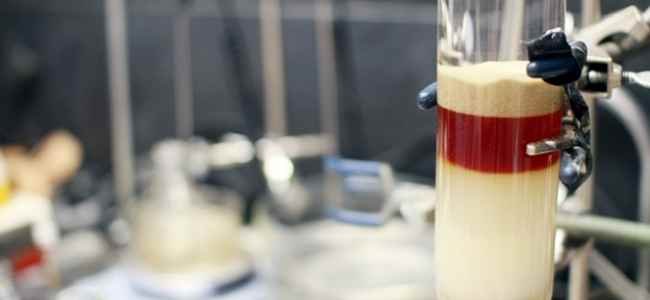
In the world of chemistry, Column Chromatography is the most crucial method for separating chemical substances. The term does sound complicated, but the process is relatively simple and is used by chemists across the globe to isolate chemicals and study them independently. It is excellent for both small and large-scale experiments and is often done to purify materials.
Meaning
Column Chromatography is a method used in chemistry to isolate a particular chemical compound from a group of chemicals. It is also done to create purer materials by removing certain chemicals and substances. The Chromatography method can be executed for both preparative and analytical purposes.
While the former is done to isolate chemical compounds for future use, the latter exclusively analyses the chemical components. Although there are different types of Chromatography methods, they have two basic steps known as the stationary and mobile phase.
Procedure for Preparing a Column
There are a few steps that one has to follow while preparing the column. First and foremost, a column must be placed so that it stands upright. After this, the bottom of the column must be filled with silica, gel, alumina, or cellulose. Underneath the column, one must place cotton or glass wool to support the column.
Once the column is ready, there are two different methods to prepare it to insert chemicals. The first, known as the wet method, is when components from both the stationary and mobile phases are merged to make a slurry.
The second step, called the dry method, is done by inserting powdery substance from the stationary phase and slushing it with liquid from the mobile phase. Both methods are used for preparing the column before the insertion of chemicals.
Stationary and Mobile Phase
Once the column is prepared, the chemicals or substances that need to be isolated are inserted. The chemicals first go through a layer called the mobile phase and then enter another layer known as the stationary phase.
When the chemicals and components go through the stationary phase, they all go at different speeds, isolating them from one another. The speed and separation of the chemicals depend on how the mobile and stationary phases have been set up. When the substances are finally separated, they are collected as fractions.
Uses
Chromatography methods that use columns are done to isolate one chemical from another. The chemicals are either isolated to be studied as separate components or considered impurities and removed from the mixture. This technique is used in pharmacies to study the effectiveness of medicines and drugs. Sometimes it is also used in the food industry to examine the chemical compounds of different foods.
Types
There are four significant types of Column Chromatography methods.
In the first type, known as adsorption, the liquids or gases from the mobile phase are adsorbed onto the surface of the stationary phase. In the second type, called the partition, the chemical compounds separate between the stationary and mobile phases in liquid form.
The third type, known as the gel, is when the chemical compounds are split between liquid stationery and a mobile gas. The fourth type, known as Ion exchange, is when chemicals are divided based on their attraction to molecules of an opposite charge.
Gas and High-Performance Liquid Chromatography
Gas and High-Performance Liquid Chromatography are types of Chromatography used in specific situations for particular results. Liquid Chromatography makes use of liquid solvents that have similar polarities, whereas Gas Chromatography uses a singular, pure gas.
Advantages
There are many advantages to using a Chromatography column method. This technique is affordable and widely used by chemists across the world. It is also easy to set up the equipment without much hassle.
But the most significant advantage of this technique is that various mixtures and materials can be isolated on a small and large scale. The separated chemicals can also be reused for future purposes.
Apparatus
The greatest perk of the Chromatography method is that it involves simple and basic apparatus. One does not have to scourge and search for the equipment, as it is fairly easy to find. The procedure requires a chromatographic tube for inserting the various chemicals.
A tampering rod can also be purchased to even out the inserted chemicals. It is also required to have glass wool or cotton to support the bottom of the column. But most importantly, one must be prepared with the chemicals they wish to isolate and the solvent and silica layer for the mobile and stationary phases.
Conclusion:
Chromatography methods using columns are a great way to isolate chemical compounds for further study and analysis.