



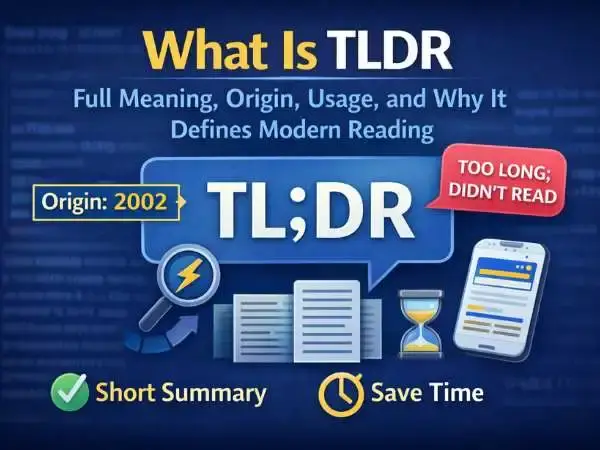
The phrase TLDR has become so common online that many people use it without ever stopping to think about what it actually represents. It shows up in comment sections, social media posts, emails, blogs, forums, and even professional documents. Despite that popularity, confusion still exists around what TLDR means, what TLDR stands for, and what is TLDR acronym.
TLDR is not just slang. It reflects a deeper shift in how people consume information. It captures frustration, efficiency, humor, impatience, and practicality—all at once. To understand TLDR fully, you need to understand not only the words but also the culture that created them.
This guide explains TLDR in detail, layer by layer, so nothing feels rushed or shallow.
What TLDR Means
At its most basic level, TLDR means “Too Long; Didn’t Read.”
That definition sounds simple, but the meaning changes depending on who is using it and why.
When someone writes TLDR, they may be saying:
- the content is long
- the content needs a summary
- the reader skipped most of it
- the writer is offering a shortcut
TLDR does not always mean disrespect. In many cases, it’s a practical response to limited time and attention.
In modern usage, TLDR often functions as a signal, not an insult. It tells readers, “If you don’t have time for everything, here’s what matters most.”
also read : – Why Professionals Need YouTube Video Summarizers
What TLDR Stands For
When people ask what TLDR stands for, the answer is direct:
Too Long; Didn’t Read
Each word plays a role:
- Too Long → the content exceeds quick reading length
- Didn’t Read → the reader chose not to engage fully
The semicolon between “Long” and “Didn’t” was common in early internet culture. Over time, many users dropped it, but the meaning stayed the same.
The phrase compresses an entire reaction into four letters, which matches the internet’s preference for speed and brevity.
What Is TLDR Acronym
An acronym is formed from the initial letters of a phrase. TLDR is an acronym built from the first letters of “Too Long; Didn’t Read.”
Unlike spoken acronyms like “NASA,” TLDR is usually spelled out letter by letter:
- T–L–D–R
People rarely pronounce it as a word. That reinforces its written, internet-based nature.
The acronym itself reflects the idea it represents: compression of information.
Where TLDR Came From
TLDR originated in early online forums and discussion boards. These spaces encouraged long, detailed posts. Over time, readers began pushing back against excessive length.
Early TLDR usage was blunt and often sarcastic. A response of “TLDR” alone usually meant:
- “I didn’t read this”
- “This is too long”
- “Condense your point”
It was not friendly. It was a form of social pressure.
But language evolves. TLDR did not stay hostile for long.
How TLDR Evolved Over Time
The major shift happened when writers started adding their own TLDR at the end of posts.
This flipped the meaning:
- From criticism → to courtesy
- From dismissal → to assistance
Instead of being attacked with TLDR, writers embraced it as a reader-friendly tool. That change helped TLDR move from fringe slang to mainstream usage.
Now, TLDR often signals awareness, not impatience.
TLDR as a Summary Tool
Today, TLDR is most commonly used as a summary marker.
Writers include a TLDR to:
- help skimmers
- highlight the core idea
- respect time constraints
A TLDR summary usually:
- appears in one or two sentences
- avoids detail
- states the main outcome or point
This makes TLDR similar to an executive summary, but much shorter and less formal.
also read : – Best Voice Recorder Apps For IPhone : Know About The Top 6 Voice Recorder Apps For IPhone
Why People Use TLDR
People use TLDR because reading habits have changed.
Modern readers:
- skim before committing
- multitask constantly
- read on small screens
- face information overload
TLDR helps readers decide quickly whether full engagement is worth their time. It gives control back to the reader.
This is not laziness. It is adaptation.
TLDR in Social Media Culture
TLDR thrives on social platforms.
On Reddit, long posts without TLDR often get comments asking for one. On Twitter, TLDR summarizes long threads. On Facebook, TLDR helps users jump past walls of text.
In these spaces, TLDR acts as:
- a social expectation
- a reading shortcut
- a tone-setter
Ignoring TLDR norms can reduce engagement.
TLDR in Professional Communication
TLDR has moved beyond casual use.
In professional settings, TLDR appears in:
- internal emails
- project updates
- reports
- presentations
Here, TLDR usually sits at the top and answers one question:
“What do I need to know right now?”
Used correctly, TLDR signals efficiency and respect.
TLDR Tone: Helpful vs Dismissive
Tone determines whether TLDR feels polite or rude.
When a writer includes TLDR:
- it feels considerate
- it helps readers
- it invites engagement
When a reader comments “TLDR” alone:
- it may feel dismissive
- it may sound sarcastic
- it can shut down discussion
Understanding this difference prevents conflict.
also read : – Firebase Alternatives: Learn About The Best Alternatives of Firebase Here
TLDR vs Summary
TLDR and summaries overlap but differ in intent.
A summary:
- may cover multiple points
- can be detailed
- often formal
A TLDR:
- focuses on one key takeaway
- remains informal
- prioritizes speed
TLDR sacrifices depth for clarity.
TLDR Placement in Content
Where TLDR appears affects how readers interact with content.
TLDR at the Top
Placing TLDR at the top:
- hooks impatient readers
- clarifies value instantly
- improves readability
Many blogs now use this approach intentionally.
TLDR at the Bottom
Bottom placement:
- rewards skimmers
- helps readers who scroll first
- works well for discussions
Both placements work when used intentionally.
TLDR and Internet Attention Spans
TLDR exists because attention is fragmented.
People:
- open many tabs
- scan headlines
- read selectively
TLDR adapts content to this reality. It does not create short attention spans—it responds to them.
TLDR and the Attention Span Debate
Critics argue TLDR promotes shallow thinking. Supporters argue it improves efficiency.
Both views hold truth.
TLDR:
- helps prioritize reading
- does not replace deep engagement
- allows choice
Readers still decide how far to go.
TLDR in Academic and Technical Writing
TLDR has entered technical spaces quietly.
Developers and researchers use TLDR to:
- summarize findings
- explain outcomes
- reduce onboarding time
In these fields, TLDR often replaces lengthy introductions.
TLDR vs Abstract
An abstract:
- follows strict structure
- summarizes full research
- is formal
A TLDR:
- informal
- outcome-focused
- flexible
They serve similar goals differently.
also read : – KeepPost – How To Download and Use It for Instagram?
TLDR in Programming Communities
Programming communities love TLDR.
Long bug reports, explanations, or debates often include TLDR to highlight:
- the issue
- the fix
- the result
This saves time and reduces confusion.
Common Misunderstandings About TLDR
Several myths persist.
- TLDR means laziness
- TLDR is always rude
- TLDR replaces reading
None of these are accurate.
TLDR is a tool, not a judgment.
How to Write a Good TLDR
Writing a good TLDR requires clarity.
A strong TLDR:
- stays short
- avoids hype
- states the conclusion
- matches the content
Bad TLDRs confuse more than they help.
TLDR in Marketing and SEO Content
Marketers use TLDR to:
- capture attention
- communicate value
- guide skimmers
Search-focused content benefits from TLDR because it improves user experience and clarity.
TLDR in Email Communication
Long emails lose readers fast.
Adding TLDR at the top:
- improves response rates
- helps decision-makers
- reduces misunderstanding
Many executives expect this now.
TLDR as a Cultural Signal
Using TLDR signals:
- awareness of reader time
- clarity of thought
- modern communication habits
It shows you understand your audience.
When TLDR Should Not Be Used
TLDR is not always appropriate.
Avoid TLDR when:
- emotional nuance matters
- storytelling is central
- context cannot be compressed
Some messages need space.
also read : – How to Find Someone’s Address Legally and Ethically
TLDR and the Future of Writing
TLDR reflects a broader shift toward reader-first writing.
As content grows longer, summaries become more valuable. TLDR may evolve in name, but not in function.
Why Understanding TLDR Matters
Understanding TLDR helps you:
- communicate clearly
- respect time
- write better content
- read more efficiently
It is not just slang. It’s a literacy tool.
Final Thoughts on What TLDR Is
TLDR stands for “Too Long; Didn’t Read,” but its meaning goes far beyond that phrase. It represents how people navigate overwhelming amounts of information. Used well, TLDR improves clarity and respect. Used poorly, it creates friction.
Knowing how TLDR works makes you a better communicator in the modern world.
also read : – Implementing a Security Operations Center Framework
FAQs: What TLDR Means
What does TLDR mean
It means “Too Long; Didn’t Read.”
What does TLDR stand for
Too Long; Didn’t Read.
What is TLDR acronym
An acronym formed from the first letters of “Too Long; Didn’t Read.”
Is TLDR rude
It depends on context and tone.
Should TLDR be used in blogs
Yes, especially for long content.