



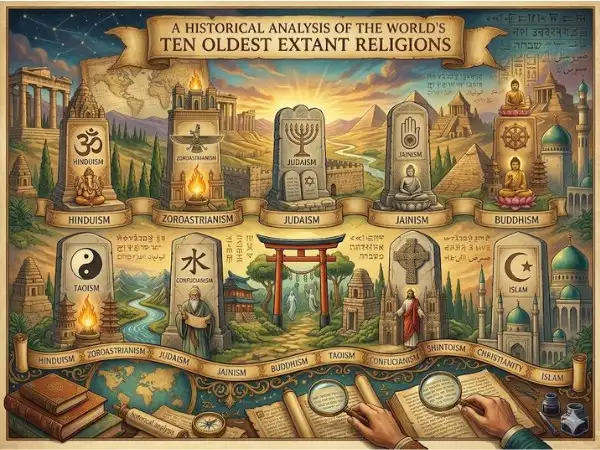
Determining the chronological origins of global belief systems presents a complex historiographical challenge. Public perception of religious history is frequently constrained by contemporary geographical distributions and a reliance on oversimplified educational curricula. Consequently, the profound historical depth and resilience of the world’s major religions are often obscured or misunderstood.
The Complexity of Historical Timelines
Contemporary societies are saturated with institutionalized religious structures; however, the ubiquitous nature of these institutions often belies their complex evolutionary trajectories. When historical pedagogy relies strictly on the rote memorization of isolated dates, it fails to convey the continuous, dynamic survival of these belief systems across millennia.
Without a rigorous academic framework, popular discourse frequently relies on conjecture or anecdotal information regarding the antiquity of various faiths. A systematic chronological analysis reveals that many of these belief systems have endured significant sociopolitical upheavals, environmental catastrophes, and the rise and fall of vast empires, maintaining continuous practice into the modern era.
Methodological Approach to Religious Antiquity
Evaluating the antiquity of modern religions requires establishing specific historical parameters. For the purposes of this analysis, the focus is placed exclusively on the oldest, longest-surviving major religions that maintain an unbroken continuum of active practice today.
The following compilation details the ten oldest extant religions globally, categorized by the approximate historical emergence of their foundational tenets. This ranking prioritizes verifiable historical continuity and global demographic significance.
10. Islam (c. 622 CE)

Islam, while currently representing the world’s second-largest and fastest-growing major religion with nearly two billion adherents, is chronologically the youngest of the faiths on this list.
The religion was established in the 7th century CE in the Arabian Peninsula (specifically in the Hejaz region encompassing Mecca and Medina), predicated on the revelations received by the Prophet Muhammad, which were subsequently codified in the Quran. As a strictly monotheistic faith centering on the worship of Allah, Islam experienced rapid geopolitical and cultural expansion following its inception, profoundly influencing global historical development.
9. Christianity (c. 1st century CE)

Originating in the 1st century CE within the context of Second Temple Judaism in the Levant, Christianity is centered on the life, teachings, and crucifixion of Jesus of Nazareth.
During its formative centuries, the faith endured systematic persecution under the Roman Empire. However, subsequent to its decriminalization and eventual endorsement by the Roman Emperor Constantine in the 4th century CE, Christianity experienced unprecedented geographic expansion. Today, it constitutes the largest single religious demographic globally.
8. Shintoism (Roots c. 700 BCE)

Shintoism, the indigenous religion of Japan, operates without a singular historical founder or a centralized, dogmatic scripture. It is deeply integrated into Japanese cultural and agrarian traditions.
The faith centers on the veneration of kami—animistic spirits or deities believed to inhabit natural elements, including topographical features, flora, and fauna. While the earliest written codifications of Shinto mythology date to the 8th century CE, the underlying oral traditions and ritualistic practices significantly predate these texts, demonstrating a profound reverence for the natural environment.
also read : – When Will the Earth End: Science, Faith, Myths, and What the Future Actually Looks Like
7. Taoism (c. 500 BCE)

Originating in ancient China, Taoism (or Daoism) is philosophically attributed to the teachings of Laozi. The foundational tenet of this belief system is achieving harmony with the “Tao,” a concept broadly translated as “the way” or the fundamental, natural order of the universe.
Taoism emphasizes balance, most notably conceptualized through the dynamic interplay of Yin and Yang. It advocates for a paradigm of non-action (wu wei) and fluidity, suggesting that optimal existence is achieved by aligning oneself with natural cosmic rhythms rather than resisting them.
6. Confucianism (c. 500 BCE)

Developing contemporaneously with Taoism, Confucianism was established by the philosopher Confucius in ancient China.
Unlike systems focused primarily on metaphysical theology or deity worship, Confucianism functions principally as a comprehensive ethical and sociopolitical framework. It heavily emphasizes filial piety, ancestral reverence, and societal harmony derived from strict adherence to hierarchical relationships and moral rectitude. This philosophy has fundamentally structured the cultural and administrative frameworks of East Asia for millennia.
5. Buddhism (c. 500 BCE)

Buddhism originated in the Indian subcontinent through the teachings of Siddhartha Gautama. Having renounced his aristocratic privileges to investigate the nature of human suffering, Gautama achieved enlightenment and subsequently became recognized as the Buddha.
The core of Buddhist doctrine is the cessation of suffering (dukkha) through the relinquishment of earthly desires and attachments. This philosophical framework is codified in the Four Noble Truths and the Eightfold Path, offering a systematic methodological approach to achieving spiritual liberation (Nirvana).
4. Jainism (c. 6th Century BCE)

Jainism is an ancient Indian religion most prominently associated with the spiritual teacher Mahavira, though its theological lineage extends further back through preceding figures known as Tirthankaras.
The central tenet of Jainism is ahimsa, or absolute non-violence toward all sentient beings. This principle is strictly adhered to, manifesting in rigorous dietary restrictions and behavioral protocols designed to minimize harm to any living entity. The faith is characterized by its profound commitment to asceticism, spiritual purity, and universal pacifism.
also read : – How Old Is the USA? A Simple Breakdown of America’s Real Age
3. Zoroastrianism (c. 1500 BCE)
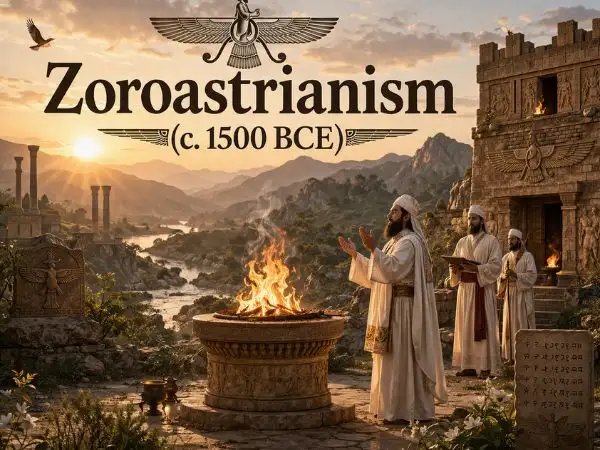
Originating in ancient Persia (contemporary Iran), Zoroastrianism was founded by the prophet Zoroaster (Zarathustra).
It is historically significant as one of the world’s earliest monotheistic—or dualistic—religions, centered on the supreme deity Ahura Mazda. Zoroastrian theology introduced foundational concepts regarding cosmic duality (a definitive struggle between good and evil), eschatology, and an afterlife, which exerted considerable ideological influence on subsequent Abrahamic religions. While its contemporary demographic is relatively small, its historical impact is substantial.
2. Judaism (c. 2000 BCE)

Judaism is the oldest of the primary Abrahamic faiths, originating in the ancient Near East. The religion is defined by a foundational covenant established between a singular God and the descendants of Abraham.
The theological and legal tenets of Judaism are codified within the Torah. The historical trajectory of the Jewish people is marked by profound adversity, displacement, and diaspora. Despite these systemic challenges, the continuous preservation of their theological traditions, legal codes, and linguistic heritage demonstrates an exceptional degree of cultural and religious resilience.
1. Hinduism (c. 2300 BCE or earlier)

Hinduism is widely recognized by historians and theologians as the oldest extant major religion globally. Developing gradually within the Indus Valley, it lacks a singular founder or a discrete foundational event.
Hinduism encompasses a vast, pluralistic synthesis of philosophies, deities, and ritualistic traditions, primarily grounded in the authority of the ancient Vedic texts. Foundational concepts such as karma (the universal principle of cause and effect) and samsara (the cycle of reincarnation) originated within this tradition. The unbroken continuity of Vedic practices over approximately four millennia underscores Hinduism’s unparalleled historical endurance.
Distinguishing Extant Religions from Extinct Mythologies
A common historiographical inquiry concerns the exclusion of the belief systems of ancient Egypt, Mesopotamia, or classical Greece from such analyses.
While these civilizations constructed monumental religious infrastructure and possessed complex pantheons, their respective religions are classified as extinct in terms of continuous, unbroken practice. They do not possess an unbroken, continuous line of practitioners into the modern era. The ten religions detailed in this analysis are defined by their uninterrupted survival and continued active practice by contemporary global populations.
Frequently Asked Questions (FAQ)
Is Animism categorized as an organized religion?
Animism—the belief that spiritual essence permeates all natural entities—is a prehistoric cognitive framework predating recorded history. However, it operates as a generalized phenomenological perspective rather than a structured, institutionalized religion with codified texts or specific founders.
Why do significant discrepancies exist regarding the dating of ancient religions?
Historiographical dating of ancient belief systems is inherently imprecise due to a reliance on archaeological evidence and the fact that many early traditions were transmitted via oral history for centuries prior to written codification. Consequently, timelines are approximate and subject to ongoing scholarly debate.
Did these ancient religious groups experience historical conflict?
The historical record indicates extensive sectarian conflict and religious warfare. Conversely, there is also substantial evidence of extensive theological syncretism, cultural exchange, and peaceful coexistence among varying belief systems throughout antiquity.
Are there pre-existing religions lost to the historical record?
Undoubtedly. Innumerable tribal and regional belief systems existed throughout prehistory. However, lacking codified texts or enduring institutional structures, these localized traditions largely disappeared alongside the populations that practiced them.
Conclusion
The study of religious history is not merely a retrospective examination of antiquity, but an analysis of continuous, evolving socio-cultural frameworks. Observing the profound historical depth of these extant religions provides critical perspective on the enduring human pursuit of existential meaning. The capacity of these institutional structures to adapt, survive, and provide continuous spiritual utility across millennia remains a testament to the resilience of human civilization.