



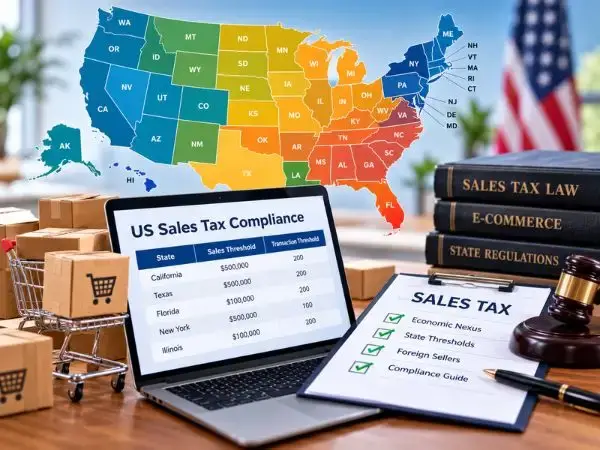
Selling into the United States from abroad has never been easier for cross-border e-commerce brands, SaaS companies, and dropshippers. However, many non-US business owners operate under a dangerous misconception: assuming that having no US company, no physical office, and no domestic warehouse exempts them from state taxes.
Ever since the landmark US Supreme Court ruling in South Dakota v. Wayfair, Inc., state tax departments have enforced economic nexus. This means that once an out-of-state or non-resident merchant exceeds a designated revenue or transaction volume delivered to customers in a specific state, a tax collection obligation is legally created.
Foreign sellers receive no special exemption under US state tax laws.
Understanding the economic nexus thresholds by state for foreign sellers is essential to avoid retroactive audits, crippling penalty interests, and frozen marketplace accounts.
1. What Foreign and International Sellers Must Know About US Sales Tax
Foreign Company (UK, EU, China, India, Canada, etc.)
                          │
          Ships Goods / Delivers Digital Products to US Buyers
                          │
                          ▼
            Exceeds State Economic Threshold (e.g., $100k)
                          │
                          ▼
         Tax Obligation Created (Economic Nexus Established)
                          │
          ┌───────────────┴───────────────┐
          ▼                               ▼
[Collect State Sales Tax]        [Register & Remit Directly]
1. Does Economic Nexus Apply Without a US Entity (EIN/SSN)?
Yes. State revenue departments assess taxability based on the destination of the customer (ship-to address), not where your business entity is incorporated. International companies based in Europe, the UK, Asia, or Canada are subject to the same thresholds and collection mandates as a domestic company operating out of Florida or Texas.
2. Physical Nexus vs. Economic Nexus (The Amazon FBA Trap)
- Physical Nexus: Created when you have tangible assets in a state. If you use Amazon FBA (Fulfillment by Amazon) or a US 3PL warehouse, the mere presence of your inventory sitting on shelves in California, New Jersey, or Illinois establishes an immediate physical nexus, overriding economic thresholds.
- Economic Nexus: Purely transaction- and revenue-based. You trigger this even if you ship products entirely via direct air freight (DDU/DDP) from overseas without storing a single box in the US.
3. Marketplace Facilitator Laws vs. Direct Sales (Shopify/WooCommerce)
Most major US platforms—including Amazon, eBay, Walmart, and Etsy—operate under Marketplace Facilitator Laws. These platforms automatically calculate, collect, and remit state sales tax on your behalf.
- The Catch for Multi-Channel Sellers: In many states, marketplace sales still count toward your economic threshold calculation.
- Example: If you sell $95,000 via Amazon (marketplace) and $10,000 via your independent Shopify store into a state with a $100,000 threshold, you cross the line and must register with that state to collect sales tax on your Shopify storefront.
2. Master Table: Economic Nexus Thresholds by State for Foreign Sellers
The majority of US states standardise their economic nexus around $100,000 in gross or retail sales. Note that most states have eliminated the standalone “200 transaction” count rule to lessen the compliance burden on low-ticket sellers.
| State | Revenue / Dollar Threshold | Transaction Count Threshold | Measurement Period | Marketplace Sales Count Toward Threshold? |
| Alabama | $250,000 | None | Previous calendar year | Excluded |
| Alaska | $100,000 (ARSSTC local) | 200 transactions | Current or preceding calendar year | Included |
| Arizona | $100,000 | None | Current or preceding calendar year | Excluded |
| Arkansas | $100,000 | 200 transactions | Current or previous calendar year | Included |
| California | $500,000 | None | Preceding or current calendar year | Included |
| Colorado | $100,000 | None | Current or previous calendar year | Included |
| Connecticut | $100,000 | 200 transactions | Prior 12-month period | Included |
| Delaware | No State Sales Tax | N/A | N/A | N/A |
| Florida | $100,000 | None | Previous calendar year | Excluded |
| Georgia | $100,000 | None (eliminated 200-tx rule) | Current or previous calendar year | Excluded |
| Hawaii | $100,000 | 200 transactions | Current or previous calendar year | Included |
| Idaho | $100,000 | None | Current or previous calendar year | Included |
| Illinois | $100,000 | None (200 tx dropped) | Prior 12-month period | Included |
| Indiana | $100,000 | None (200 tx dropped) | Current or previous calendar year | Included |
| Iowa | $100,000 | None | Current or previous calendar year | Included |
| Kansas | $100,000 | None | Current or previous calendar year | Included |
| Kentucky | $100,000 | None (200 tx dropped) | Current or previous calendar year | Included |
| Louisiana | $100,000 | None (200 tx dropped) | Current or previous calendar year | Excluded |
| Maine | $100,000 | None | Current or previous calendar year | Excluded |
| Maryland | $100,000 | 200 transactions | Current or previous calendar year | Included |
| Massachusetts | $100,000 | None | Prior 12-month period | Included |
| Michigan | $100,000 | 200 transactions | Current or previous calendar year | Included |
| Minnesota | $100,000 | None (200 tx dropped) | Prior 12-month period | Included |
| Mississippi | $250,000 | None | Prior 12-month period | Included |
| Missouri | $100,000 | None | Preceding 12-month period | Included |
| Montana | No State Sales Tax | N/A | N/A | N/A |
| Nebraska | $100,000 | None (200 tx dropped) | Current or previous calendar year | Included |
| Nevada | $100,000 | 200 transactions | Current or previous calendar year | Included |
| New Hampshire | No State Sales Tax | N/A | N/A | N/A |
| New Jersey | $100,000 | 200 transactions | Current or previous calendar year | Included |
| New Mexico | $100,000 | None | Current or previous calendar year | Included |
| New York | $500,000 AND 100 tx | 100 transactions (Both required) | Preceding 4 quarters | Included |
| North Carolina | $100,000 | None | Current or previous calendar year | Included |
| North Dakota | $100,000 | None | Current or previous calendar year | Excluded |
| Ohio | $100,000 | None (200 tx dropped) | Current or previous calendar year | Included |
| Oklahoma | $100,000 | None | Current or previous calendar year | Included |
| Oregon | No State Sales Tax | N/A | N/A | N/A |
| Pennsylvania | $100,000 | None | Preceding 12-month period | Included |
| Rhode Island | $100,000 | 200 transactions | Preceding calendar year | Included |
| South Carolina | $100,000 | None | Current or previous calendar year | Included |
| South Dakota | $100,000 | None | Current or previous calendar year | Excluded |
| Tennessee | $100,000 | None | Prior 12-month period | Included |
| Texas | $500,000 | None | Preceding 12 calendar months | Included |
| Utah | $100,000 | None | Current or previous calendar year | Excluded |
| Vermont | $100,000 | None (200 tx dropped) | Preceding 12-month period | Included |
| Virginia | $100,000 | 200 transactions | Current or previous calendar year | Included |
| Washington | $100,000 | None | Current or previous calendar year | Included |
| West Virginia | $100,000 | 200 transactions | Current or previous calendar year | Included |
| Wisconsin | $100,000 | None | Current or previous calendar year | Excluded |
| Wyoming | $100,000 | None | Current or previous calendar year | Excluded |
(Note: The 5 states with no statewide sales tax are Alaska, Delaware, Montana, New Hampshire, and Oregon—often called the NOMAD states. However, localized sales taxes in Alaska are coordinated through the ARSSTC commission).
also read : – The Future of AI in 2026: Why Claude AI by Anthropic is Trending
3. The 3 Types of Nexus Triggers: “Or”, “And”, & “Dollar-Only”
Foreign business owners must check the exact legal wording of the target state’s statute:
- Dollar-Only Thresholds (The Modern Standard):States like Texas, California, Washington, and Illinois base liability purely on total gross or retail sales ($100k or $500k) regardless of how many individual packages were delivered.
- “OR” Thresholds (Volume OR Transactions):States like New Jersey and Michigan enforce an “OR” rule. If you sell $20,000 of low-cost goods across 205 transactions, you have established economic nexus, even though you did not hit $100,000.
- “AND” Thresholds (Both Criteria Required):New York enforces a dual-condition rule: you only cross nexus if you hit $500,000 AND 100 separate transactions delivered into the state within the prior four sales tax quarters.
4. How Foreign Sellers Can Register for US Sales Tax (Without SSN)
If you cross an economic threshold in a direct channel (Shopify, digital downloads, SaaS), you must complete the foreign seller registration sequence:
[Cross State Economic Nexus Threshold]
                  │
                  ▼
[Obtain a US Federal Employer Identification Number (FEIN)]
(Foreign companies can acquire this via IRS Form SS-4 by fax/phone without an SSN)
                  │
                  ▼
[Apply for State Sales Tax Permit / Certificate of Authority]
                  │
                  ▼
[Configure Destination-Based Tax Automation (Stripe Tax, Avalara, TaxJar)]
                  │
                  ▼
[File Returns Monthly, Quarterly, or Annually]
- Get an IRS Employer Identification Number (EIN): Non-resident corporate entities can apply by submitting IRS Form SS-4. You do not need a US Social Security Number (SSN) or Individual Taxpayer Identification Number (ITIN); you mark “Foreign” on the form.
- Register with the State Department of Revenue: Most state registration portals accept foreign corporate addresses and EINs. A few states (like California and Texas) may require foreign entity registration or a nominal bond if you lack a domestic banking presence.
- Streamlined Sales Tax (SST) Registration: Foreign businesses selling nationwide can use the Streamlined Sales and Use Tax Agreement (SST) central registration system to register across 24 participating states in a single submission.
5. What Happens If a Foreign Seller Ignores Economic Nexus?
Because foreign entities have no domestic physical footprint, some international brands assume state tax departments cannot enforce compliance.
This assumption is flawed for three reasons:
- No Statute of Limitations: If you never register for a sales tax permit, the state’s audit statute of limitations never begins. States can assess back taxes 5 to 7 years later, adding statutory interest (often 10%–18% per year) and severe failure-to-file penalties.
- Frozen Merchant Processors: State revenue departments frequently subpoena payment processors (Stripe, PayPal, Shopify Payments) to identify remote merchants shipping significant volume into their jurisdiction. States can levy merchant payouts directly at the processing level.
- Exit Valuation Reduction: If you decide to sell your e-commerce brand to an aggregator or private equity firm, sales tax audits during technical due diligence can reduce your valuation or stall an acquisition.
Frequently Asked Questions (FAQ)
Do foreign companies have to collect US sales tax?
Yes. If a foreign business sells directly to consumers through an online store (such as Shopify or WooCommerce) and exceeds an individual state’s economic nexus threshold (typically $100,000 in annual sales), it is legally obligated to register, collect, and remit state sales tax.
What is the most common US economic nexus threshold?
The standard economic nexus threshold across the vast majority of US states is $100,000 in gross or retail sales delivered to in-state buyers over the current or preceding calendar year.
Do Amazon FBA sales trigger economic nexus for foreign sellers?
Amazon collects and remits sales tax automatically under Marketplace Facilitator Laws. However, storing physical inventory in Amazon’s US fulfillment centers creates an automatic physical nexus in those states, which may require state registration and non-collecting informational returns.
Can a foreign business register for US sales tax without an SSN?
Yes. Non-US residents and foreign corporations can obtain an Employer Identification Number (EIN) from the IRS without an SSN by submitting Form SS-4. State revenue departments accept foreign business registrations using an EIN.