



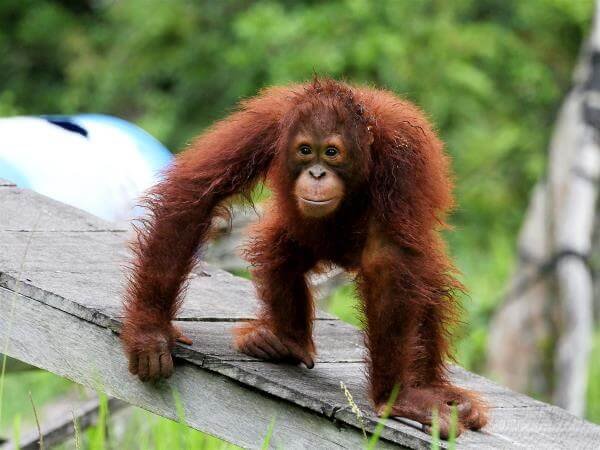
Orangutans are among the most fascinating great apes on Earth. Their red hair, long arms, and calm nature make them easy to recognize. But their future is far less secure.
Today, three orangutan species live in the wild: the Bornean, Sumatran, and Tapanuli orangutans. All three face serious pressure from forest loss, hunting, and illegal wildlife trade. WWF estimates about 104,700 Bornean, 13,846 Sumatran, and fewer than 800 Tapanuli orangutans remain.
That raises some simple questions. How long does an orangutan live? How many are left? Why are orangutan babies targeted by traffickers? And why is the Tapanuli orangutan so rare?
Let’s look at each question.
Orangutan Life Span
The orangutan life span is much longer than many people expect.
In the wild, orangutans can live for around 35 to 45 years. Some individuals in human care may live longer. Their slow growth and long care period make their life cycle quite different from many other mammals.
Young orangutans stay close to their mothers for years. WWF says young orangutans can remain with their mothers for up to eight years. That is the longest mother-young period among the great apes.
This long bond has a downside for population growth. Female orangutans usually give birth to one infant at a time, with births spaced several years apart. WWF gives an average interval of about three to five years.
So, when an adult female dies, the loss can affect more than one generation.
How Many Orangutans Are Left in the World?
If you search how many orangutans are left in the world, you may find different figures. Population estimates change as scientists improve surveys and update habitat data.
Current WWF figures give these estimates:
| Orangutan species | Estimated wild population | Conservation status |
| Bornean orangutan | About 104,700 | Endangered |
| Sumatran orangutan | About 13,846 | Critically Endangered |
| Tapanuli orangutan | Fewer than 800 | Critically Endangered |
Adding these figures gives roughly 119,000 wild orangutans. The number should be treated as an estimate, not an exact global count.
A century ago, more than 230,000 orangutans may have lived in the wild. Their decline is linked to forest loss, hunting, fires, agriculture, and illegal trade.
The Bornean orangutan has the largest population of the three. Yet even this species has suffered a major decline.
What Is the Tapanuli Orangutan?
The Tapanuli orangutan is the newest recognized orangutan species.
Scientists announced it as a separate species in 2017. Its scientific name is Pongo tapanuliensis. It lives in the Batang Toru area of North Sumatra, Indonesia.
Its population is estimated at fewer than 800 animals. That makes it one of the rarest great apes on Earth.
The species is also unusual from an evolution point of view. Genetic research found that the Tapanuli population has been separated from other orangutans for thousands of years.
For someone studying wildlife, the Tapanuli orangutan is a useful example of how new species can be identified through genetic and physical evidence.
Its small population creates another problem. When numbers fall this low, the loss of even a small group can hurt genetic diversity and breeding.
Why Are Orangutan Babies in Danger?
Orangutan babies look small, helpless, and appealing. That makes them a target for the illegal pet trade.
A baby orangutan cannot live normally without its mother. Young orangutans cling to their mothers and depend on them for food, safety, and learning.
Poachers often target females with infants. WWF reports that mothers are often killed when young orangutans are taken for illegal pets.
The Orangutan Foundation International has reported that many rescued infants lost their mothers before reaching rescue centers. Some were found after being kept illegally as pets.
This creates a tragic chain.
A hunter captures a mother and baby. The mother may be killed. The baby is taken away and sold. The young animal then faces stress, poor care, and a life far from its forest home.
So the loss of one baby can mean the loss of its mother too.
Orangutan Smuggling and Illegal Wildlife Trade
Orangutan smuggling is part of the wider illegal wildlife trade.
Live orangutans may be captured and moved for the pet trade. Their body parts can also enter illegal markets. WWF reports that young orangutans remain a target, while orangutan parts have also been traded in Kalimantan.
The trade is especially harmful due to the species’ slow reproduction.
Imagine removing several young animals from a population that already produces offspring slowly. Recovery can take many years.
International trade rules add legal protection. Orangutans are covered by CITES, the global agreement that regulates international trade in listed wild species. The CITES Trade Database records official wildlife trade reports from member countries.
But laws alone can’t protect orangutans. Rangers, customs officers, police, local communities, and conservation groups all have roles in stopping illegal capture and trade.
Habitat Loss Is a Bigger Problem
Illegal trade gets a lot of attention, but forest loss remains a major threat.
Orangutans depend heavily on forests. They spend most of their lives in trees and use forests for food, shelter, and nesting.
Forests are cleared for agriculture, plantations, roads, mining, and other human activity.
Bornean orangutans have also suffered from hunting, logging, forest fires, and conflict with people. WWF reports that the 1997–98 forest fires in Kalimantan may have killed as many as 8,000 orangutans.
Forest loss creates another issue. Orangutans may enter farms when food becomes scarce. Farmers can then see them as pests or threats to crops.
That can lead to conflict, injury, or death.
Why Are Orangutans Important to Forests?
Orangutans aren’t just forest residents. They help forests grow.
They eat many types of fruit and spread seeds across large areas. Some seeds pass through their digestive system and later grow into new plants.
WWF describes orangutans as important seed dispersers and notes that more than 500 plant species have been recorded in the Bornean orangutan diet.
I find this part especially interesting. Protecting one animal can help protect an entire forest system.
When orangutan numbers fall, the effect isn’t limited to the animals themselves. Forest plants and other species can feel the impact too.
Orangutan UPSC Notes
The keyword orangutan UPSC is useful for students preparing for the Civil Services Examination. Orangutans fit into topics such as biodiversity, endangered species, wildlife conservation, habitat loss, and illegal wildlife trade.
Here are quick facts for revision:
- Genus: Pongo
- Three species: Bornean, Sumatran, and Tapanuli
- Main range: Borneo and Sumatra
- Bornean scientific name: Pongo pygmaeus
- Sumatran scientific name: Pongo abelii
- Tapanuli scientific name: Pongo tapanuliensis
- Tapanuli population: Fewer than 800
- Main threats: Habitat loss, hunting, forest fires, and illegal wildlife trade
- Diet: Mainly fruit, with leaves, shoots, insects, bark, and other foods
- Life span in the wild: About 35–45 years
UPSC’s official syllabus and question-paper resources include ecology, biodiversity, conservation, and wildlife-related areas, making orangutans a useful example for these subjects.
What Can Be Done to Protect Orangutans?
The solution starts with protecting forests.
Conservation groups work on habitat protection, forest restoration, anti-poaching efforts, rescue work, and community programs. WWF also works with TRAFFIC to help stop illegal wildlife trade and support law enforcement.
Rescue is only one part of the work. A rescued orangutan still needs food, medical care, training, and a safe forest before release.
The bigger goal is simple: keep wild orangutans in healthy forests where they belong.
Frequently Asked Questions
How long is an orangutan’s life span?
An orangutan can live around 35 to 45 years in the wild. Some may live longer under human care.
How many orangutans are left in the world?
Current WWF estimates put the wild population at about 104,700 Bornean, 13,846 Sumatran, and fewer than 800 Tapanuli orangutans.
Why is the Tapanuli orangutan so rare?
The Tapanuli orangutan has a very small range and population. Forest loss and human pressure threaten its remaining habitat.
Why are orangutan babies smuggled?
Young orangutans are targeted for the illegal pet trade. Mothers are often killed when their babies are captured.
Are orangutans endangered?
Yes. The three species face serious conservation threats. WWF lists the Bornean orangutan as Endangered and the Sumatran and Tapanuli orangutans as Critically Endangered.
Where do orangutans live?
Wild orangutans are found on the islands of Borneo and Sumatra in Southeast Asia.
Final Takeaway
The story of the orangutan is more than a story about a rare animal.
It connects forests, wildlife crime, climate pressure, farming, and human choices.
The orangutan life span may reach four decades, but its population takes far longer to recover after major losses. The Tapanuli orangutan shows how serious the problem has become, with fewer than 800 animals estimated to remain.
If you’re studying orangutan UPSC topics, focus on three links: habitat loss, low reproduction, and illegal wildlife trade.
And if you’ve ever wondered how many orangutans are left in the world, the answer is roughly 119,000 based on current WWF estimates. That number may sound large at first. Look closer, though, and the picture changes—the rarest species has fewer than 800 animals left.
Protecting their forests is the best chance these remarkable apes have for a future.