



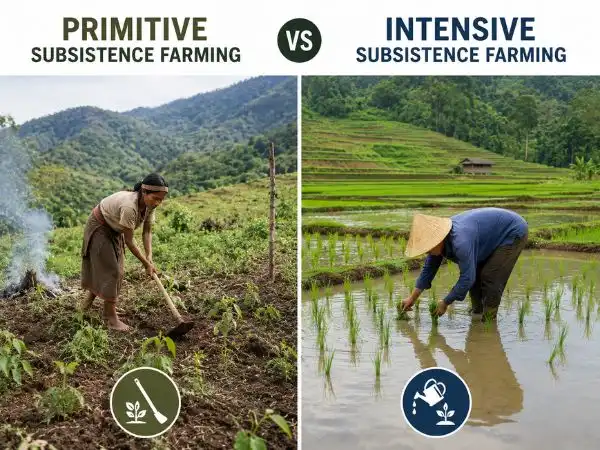
Farming is an ancient science. People around the world involved in the agricultural sector for a very long time. Subsistence farming is one of the oldest farming styles used to grow crops and raise animals for personal use. This approach relies on small plots of land to produce food for families. Broadly, there are two main types of subsistence farming: primitive subsistence farming and intensive subsistence farming. Each has different methods, advantages, and challenges. Intensive farming is more technologically advanced, while primitive farming tends to be more organic but produces less. Below we explain both systems and highlight their differences.
Define Primitive Subsistence Farming
Primitive subsistence farming refers to traditional agricultural practices where families grow just enough food to meet their own needs. These farmers typically work small plots of land, use simple tools (like digging sticks), and rely on natural soil fertility and seasonal rains rather than chemical inputs. Production is primarily for household consumption; any small surplus may be bartered or sold locally. Primitive systems are common in rural areas and emphasize local knowledge, low external inputs, and organic methods. The basic aim remains food security for the family rather than commercial profit.
Define Intensive Subsistence Farming
Intensive subsistence farming is practiced in densely populated regions where landholdings are small but farmers seek to maximize output from each parcel. This system uses more labor, irrigation, and external inputs—such as chemical fertilizers, pesticides, and high‑yielding crop varieties—to raise productivity. Farmers often work intensively, sometimes hiring additional labor, and use modern techniques to increase yields for both family consumption and market sale. The focus is on achieving high production per unit area, frequently to generate income as well as food.
also read : – A Historical Analysis of the World’s Ten Oldest Extant Religions
Difference between Primitive and Intensive Subsistence Farming
There are several clear differences between the two approaches:
- Land size and intensity
Primitive farming is carried out on very small patches using low‑input methods. Intensive subsistence farming is practiced on small but more intensively managed plots, often with higher labor and input use to boost yields. - Techniques and tools
Primitive farming relies on traditional tools and methods (digging sticks, simple hoes) and natural soil fertility. Intensive farming uses modern tools, irrigation, fertilizers, pesticides, and sometimes mechanization to increase production. - Purpose and output
Primitive farming aims primarily to feed the household, with only occasional surplus for sale. Intensive farming aims for higher productivity and often produces crops for both consumption and commercial sale. - Water and soil management
Primitive systems depend largely on monsoon rains and natural soil fertility. Intensive systems commonly use irrigation (canals, wells) and soil amendments to secure reliable, higher yields. - Location and population context
Primitive farming is more common in remote rural areas with lower population density. Intensive subsistence farming is typical in high population density regions where land is scarce and farmers must extract more output from limited area.
So Which Farming Style Is Best
There is no single “best” style—each has advantages and trade‑offs. Primitive farming supports organic practices, low external input costs, and cultural continuity, but it usually yields less and can leave families vulnerable to poor seasons. Intensive subsistence farming raises productivity and can improve food security and incomes, but it often depends on chemical inputs, irrigation, and greater labor, which can cause soil degradation, pollution, and long‑term sustainability concerns if mismanaged. Ultimately, the choice depends on local conditions, farmer goals, resource availability, and long‑term sustainability priorities. Many modern approaches seek a middle path: improving yields with sustainable practices (integrated pest management, organic amendments, water‑saving irrigation) so farmers gain productivity without sacrificing environmental health.
also read : – When Will the Earth End: Science, Faith, Myths, and What the Future Actually Looks Like
Conclusion
Both primitive and intensive subsistence farming techniques have roles to play in feeding communities. Primitive farming emphasizes low‑input, traditional methods and household self‑sufficiency, while intensive subsistence farming focuses on maximizing production from limited land using labor, irrigation, and inputs. Understanding the differences helps policymakers, extension workers, and farmers choose or adapt practices that balance productivity, income, and environmental sustainability. We hope this blog provides clear information about the difference between primitive and intensive subsistence farming techniques. Thanks for reading.