


By Piyush | November 2026 | 9 min read
—
### Quick Takeaways (TL;DR)
– What is the core goal of yoga? Sutra 1.2 nails it: Yogas Citta-V?tti-Nirodha?-yoga is quieting the noisy churn of your mind.
– The 4 Chapters (Padas): Samadhi Pada (mind absorption), Sadhana Pada (daily action & limbs), Vibhuti Pada (inner mastery), and Kaivalya Pada (freedom).
– The 8 Limbs: Yama (social ethics), Niyama (habits), Asana (steady seat), Pranayama (breath), Pratyahara (quieting senses), Dharana (focus), Dhyana (flow), and Samadhi (oneness).
– Two Golden Rules: Consistent daily effort (Abhyasa) paired with letting go of results (Vairagya).
—
A few years back, when I first started practicing yoga, I thought it was all about flexible hamstrings, sweaty vinyasa flows, and holding handstands.
Then my teacher handed me a beat-up copy of Patanjali’s text.
I flipped to the second verse and read: Yogas Citta-V?tti-Nirodha?. That single line stopped me dead in my tracks.
Out of 196 verses, Patanjali talks about physical postures (Asana) in only three lines. The rest of the work is an unfiltered manual on how the human mind works, why we feel stressed, and how to train your attention so you stop reacting to every chaotic thought that crosses your head.
If you are studying for your Yoga Teacher Training (YTT), preparing for yoga certification exams, or just trying to calm a restless mind, here is an exact, verse-by-verse breakdown of the Patanjali Yoga Sutras.
—
What Are the Patanjali Yoga Sutras?
Compiled around 400 CE by Sage Patanjali, the Yoga Sutras gather ancient Vedic psychology into 196 terse aphorisms (sutras) across 4 chapters.
Key Characteristics:
– Systematic road map: Lays out Raja Yoga (the royal path of meditation).
– Practical psychology: Treats the mind like an instrument you can observe and train.
– Rooted in dualism: Distinguishes between changing matter (Prakriti) and pure conscious awareness (Purusha).
– Universal framework: Requires no rigid dogma; you can practice these rules no matter your background.
—
Core Breakdown of the 4 Padas (Chapters)
Patanjali structured his work into four logical books, termed Padas (steps or feet):
| Chapter (Pada) | Number of Sutras | Core Subject | Practical Focus |
|---|---|---|---|
| 1. Samadhi Pada | 51 Sutras | Absorption & Nature of Mind | Defining quiet awareness, mind patterns, and deep meditation states. |
| 2. Sadhana Pada | 55 Sutras | Practice & Action (Kriya) | Overcoming suffering (Kleshas), building Kriya Yoga, and the first 5 limbs. |
| 3. Vibhuti Pada | 56 Sutras | Inner Mastery & Byproducts | Triple-fold focus (Samyama), mental powers, and avoiding spiritual ego traps. |
| 4. Kaivalya Pada | 34 Sutras | Absolute Freedom & Liberation | Karma, root impressions (Samskaras), and the total liberation of the soul. |
—
Overview of the 4 Chapters (Padas) of Patanjali’s Yoga Sutras
Let’s unpack each chapter so you understand how the philosophy builds step-by-step.
Chapter 1: Samadhi Pada (51 Sutras – Absorption & Nature of Mind)
Samadhi Pada jumps straight into the deep end. It is addressed to practitioners who already have a relatively quiet mind and want to know the ultimate goal.
Patanjali opens with his iconic thesis:
“Atha yoganusasanam” (Sutra 1.1)
Now, the instruction on Yoga begins.
He immediately follows this with the core definition of yoga: stilling the fluctuations of the mind (Yogas Chitta Vritti Nirodhah). This chapter explains what the mind is made of, why it jumps around like an unsettled monkey, and how deep absorption (Samadhi) brings genuine inner quiet.
Chapter 2: Sadhana Pada (55 Sutras – Practice & Kriya Yoga)
Most of us do not wake up with a quiet mind. We have bills to pay, busy jobs, and busy homes.
Sadhana Pada is written for the rest of us. It outlines Kriya Yoga (the yoga of action):
1. Tapas: Disciplined heat and healthy habits.
2. Svadhyaya: Honest self-reflection and studying grounding texts.
3. Ishvara Pranidhana: Surrendering our frantic need to control every outcome.
In this chapter, Patanjali also breaks down the 5 root causes of human misery (the Kleshas: ignorance, ego, craving, aversion, and fear of loss) and lays out the foundational steps of the Eight Limbs of Ashtanga Yoga.
Chapter 3: Vibhuti Pada (56 Sutras – Powers & Inner Mastery)
Once your body is steady and your senses are calm, you move into the internal practices: concentration (Dharana), effortless meditative flow (Dhyana), and total absorption (Samadhi).
When these three run together on a single object, Patanjali calls it Samyama.
Mastering Samyama sharpens your intuition. The text notes that practitioners develop extraordinary mental focus and abilities (Siddhis). But Patanjali gives an upfront warning: treat these powers as mere byproducts. If you get caught up bragging about them, you fall right back into the trap of ego.
Chapter 4: Kaivalya Pada (34 Sutras – Absolute Freedom & Liberation)
The word Kaivalya means “aloneness” or absolute independence.
This final chapter reads like advanced neuroscience mixed with metaphysics. It investigates where our deeply buried psychological habits (Samskaras) come from, how our past actions shape current thoughts, and how to untangle pure consciousness (Purusha) from everyday mental chatter. The finish line is complete, lasting freedom from mental suffering.
—
Key Sanskrit Aphorisms & Mental Modifications (Vrittis)
To truly grasp Patanjali, you must understand three key Sanskrit concepts that form the backbone of his system.
Deconstructing Yogas Citta-V?tti-Nirodha? (Sutra 1.2)
This is the foundational verse of classical yoga:
$$\text{Yoga} = \text{Citta} + \text{V?tti} + \text{Nirodha}$$
– Yoga: Union, integration, clear connection.
– Citta (Chitta): The entire field of mind-stuff, including conscious thoughts, subconscious memories, and the ego.
– V?tti (Vritti): Whirlpools, ripples, waves, or fluctuations.
– Nirodha?: Stilling, quiet containment, or calming.
A classic metaphor fits well here: think of your mind as a mountain lake. When the wind kicks up waves (vrittis) and stirs up mud, you cannot see the lake bottom. Calm the water, and the sandy bed becomes crystal clear.
The 5 Modifications of Mind (Chitta Vrittis)
Patanjali notes that every single thought passing through your head falls into one of five categories (Sutras 1.5-1.11). Some help you, while others cause unnecessary pain:
1. Pramana (Right Knowledge): Direct perception, sound logic, or verified evidence. You see an apple on the counter, and you know it is an apple.
2. Viparyaya (Error / Misconception): Mistaken perception. You spot a coiled garden hose in dim light and panic, thinking it is a snake.
3. Vikalpa (Imagination / Fantasy): Mental stories spun out of words without physical reality. Worrying endlessly about worst-case scenarios that never happen is a classic Vikalpa.
4. Nidra (Deep Sleep): The mind state that rests on the experience of nothingness.
5. Smriti (Memory): Retaining and replaying past experiences, whether sweet or bitter.
When you notice your mind racing, ask yourself: Which vritti is active right now? Just naming it weakens its grip.
The Two Pillars of Mastery: Abhyasa & Vairagya (Sutra 1.12)
How do you tame these five mental whirlpools? Patanjali gives a two-part answer in Sutra 1.12:
“Abhyasa-vairagyabhya? tan-nirodha?”
These mental patterns are stilled through continuous practice and non-attachment.
– Abhyasa (Steady Effort): Showing up on your mat or cushion day after day with patience and reverence, even when you feel sluggish.
– Vairagya (Non-Attachment): Dropping your obsession with immediate results. You do the work, but you stop fretting about whether you had a “good” or “bad” meditation session.
Think of Abhyasa and Vairagya like the two wings of a bird. Effort keeps you moving forward, while non-attachment keeps you steady and level.
—
The Eight Limbs of Ashtanga Yoga (Sadhana Pada Step-by-Step)
In Sutra 2.29, Patanjali introduces the famous Ashtanga (Ashta = eight, Anga = limb) system. These are not eight sequential steps you tick off like a grocery list. They grow together like branches on a healthy tree.
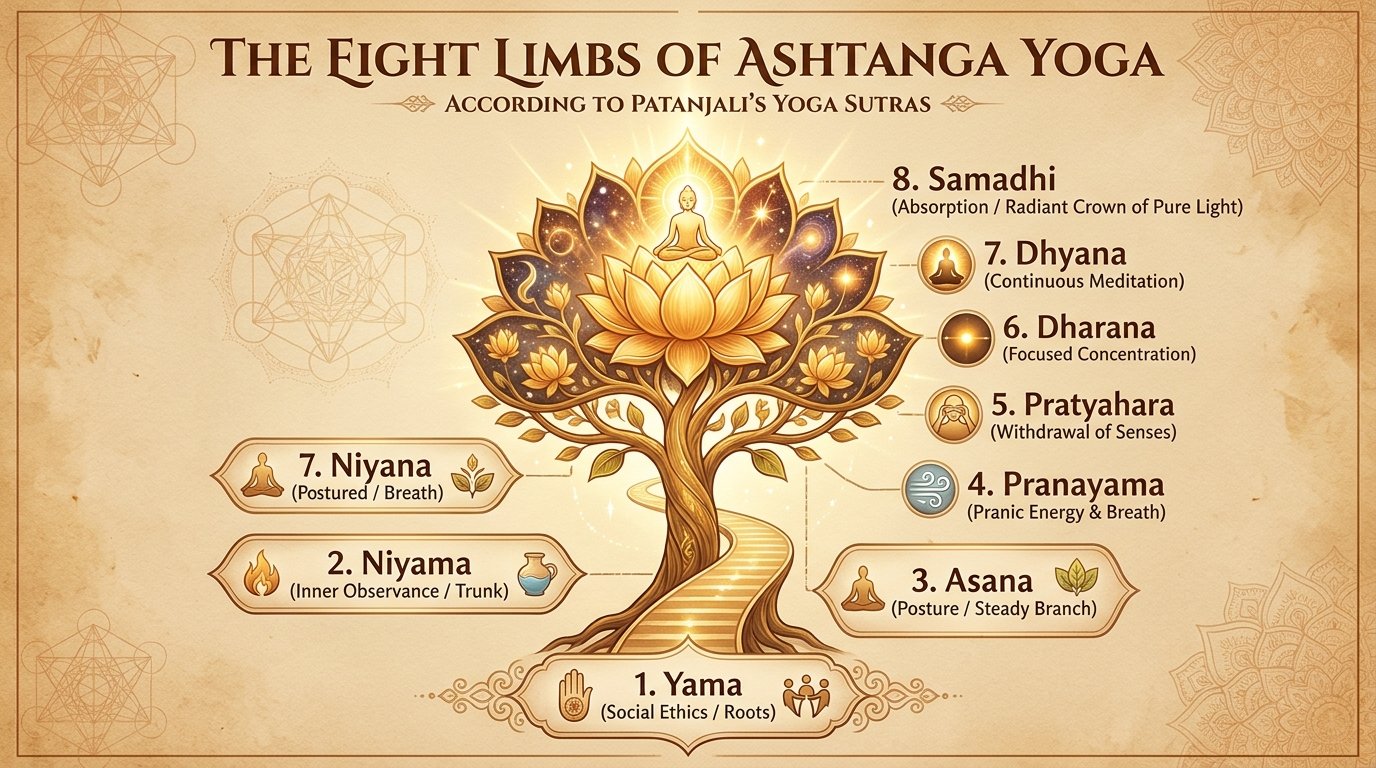
The 8 Limbs of Classical Yoga
??? 1. Yamas        (Ethical Restraints toward the world)
??? 2. Niyamas      (Personal Observances & Daily Habits)
??? 3. Asana        (Steady, Comfortable Physical Seat)
??? 4. Pranayama    (Breath Regulation & Energy Expansion)
??? 5. Pratyahara   (Sensory Withdrawal & Digital Detox)
??? 6. Dharana      (Single-Pointed Concentration)
??? 7. Dhyana       (Unbroken Meditative Flow)
??? 8. Samadhi      (Complete Absorption & Inner Oneness)
1. External Disciplines (Yamas & Niyamas)
#### The 5 Yamas (Harmonizing Relationships):
– Ahimsa (Non-violence): Gentleness in your actions, words, and thoughts toward yourself and others.
– Satya (Truthfulness): Speaking and living the truth with kindness.
– Asteya (Non-stealing): Not taking what isn’t yours, including other people’s time or credit.
– Brahmacharya (Energy Moderation): Directing your vital life energy with care instead of scattering it on mindless distractions.
– Aparigraha (Non-possessiveness): Letting go of hoarding, jealousy, and greedy grasping.
#### The 5 Niyamas (Cultivating Inner Purity):
– Shaucha (Cleanliness): Clean body, clean food, clean room, and clear mental diet.
– Santosha (Contentment): Finding peace with what you have right here, right now, rather than postponing happiness.
– Tapas (Self-Discipline): The healthy friction of sticking to commitments that build character.
– Svadhyaya (Self-Study): Observing your behavioral blind spots and reading uplifting wisdom texts.
– Ishvara Pranidhana (Surrender): Releasing your ego to a higher order or divine reality.
2. Physical & Energetic Preparation (Asana & Pranayama)
Patanjali defines physical posture in Sutra 2.46 with remarkable brevity:
“Sthira-sukham-asanam”
Posture must be steady (sthira) and comfortable (sukha).
That’s it. You don’t need pretzel contortions. The goal of asana is simply to sit with a relaxed, upright spine so your back does not scream in pain while you breathe and meditate.
Once your seat is stable, Pranayama regulates the rhythm of inhalation, exhalation, and retention. Calming your breath directly sends a safety signal to your nervous system.
3. Sensory Withdrawal & Inner Concentration (Pratyahara & Dharana)
Our senses are constantly pulled outward by smartphone alerts, emails, and street noise.
– Pratyahara (Sensory Withdrawal): Drawing your senses inward, like a tortoise pulling its limbs into its shell. You stop letting external sounds pull your attention off-course.
– Dharana (Concentration): Binding your mind to one specific spot. It could be the sensation of breath passing your nostrils, a candle flame, or a simple mantra. When your attention wanders-and it will-you gently steer it back.
4. Meditative Absorption & Union (Dhyana & Samadhi)
– Dhyana (Meditation): When concentration (Dharana) stops feeling like hard work and turns into an unbroken, smooth stream of awareness.
– If Dharana is water dripping drop by drop from a pitcher, Dhyana is oil pouring in a continuous, smooth flow.
– Samadhi (Absorption): The sense of a separate “meditator” melts away. You merge fully with the object of contemplation. Pure peace takes over.
For those interested in exploring structured, devotional meditative methods that develop this state, take a look at our detailed breakdown in the Raseshwari Devi World Meditation Day Guide.
—
Top Recommended Commentaries & Modern Application Guide
Because Patanjali wrote in concise Sanskrit code, you need a dependable guide to unpack the verses.
Classic & Modern Books for Yoga Teacher Training (YTT)
For an authentic audio-visual immersion into classical Raja Yoga and the philosophy of the Yoga Sutras, watch Swami Sarvapriyananda’s acclaimed discourse series from the Vedanta Society:
| Commentary / Book | Author | Difficulty | Best For |
|---|---|---|---|
| The Yoga Sutras of Patanjali | Swami Satchidananda | Beginner to Intermediate | The gold standard for modern 200-hour YTT programs. Clear Sanskrit word breakdowns with warm, practical examples. |
| Raja Yoga | Swami Vivekananda | Intermediate | The 1896 classic that brought Patanjali to the West. Crisp, commanding, and focused on psychology and will. |
| Yoga Bhashya | Sage Vyasa | Advanced | The ancient canonical commentary. Essential reading for deep philosophical research and scholarly rigor. |
How to Apply Yoga Philosophy to Modern Stress Management
You don’t have to live in a cave in Rishikesh to benefit from Patanjali. Here is how I weave these ideas into a hectic weekday:
1. Practice Santosha on Your Morning Commute: When traffic stalls or your train gets delayed, catch your frustration in real time. Remind yourself that anger won’t speed up the vehicle. Choose contentment with the moment.
2. 1-Task Dharana at Your Desk: Stop multi-tasking across 20 browser tabs. Pick one report, one email, or one coding task, close distractions, and focus your mind on that single activity for 25 minutes. That is modern Dharana in action.
3. Daily Evening Pratyahara: Give yourself a 30-minute digital sunset before bed. Put your phone in another room to let your senses disengage from endless blue light and social media noise.
—
Frequently Asked Questions (FAQs)
What is the true meaning of Yogas Chitta Vritti Nirodhah?
It translates directly to “Yoga is the stilling of the fluctuations of consciousness.” It means yoga is not about making shapes with your body; it is about calming mental turbulence so you experience inner stillness.
What is the difference between Yamas and Niyamas?
Yamas are social guidelines teaching how you treat others (non-violence, truth, non-stealing). Niyamas are personal habits teaching how you treat yourself (cleanliness, contentment, discipline, study, surrender).
How do Dharana, Dhyana, and Samadhi differ?
Dharana is effortful, focused concentration on an object. Dhyana is effortless, continuous awareness flow toward that object. Samadhi is total absorption where the division between you and the object disappears.
Do I need to be flexible to study the Yoga Sutras?
Not at all. Patanjali only asks that you find a posture that is steady and comfortable (Sthira Sukham Asanam). The real workout happens in your mind, not in your joints.
—
Which of Patanjali’s 8 limbs do you find hardest to practice in your daily routine? Leave a comment below, and let’s discuss practical ways to work through it!